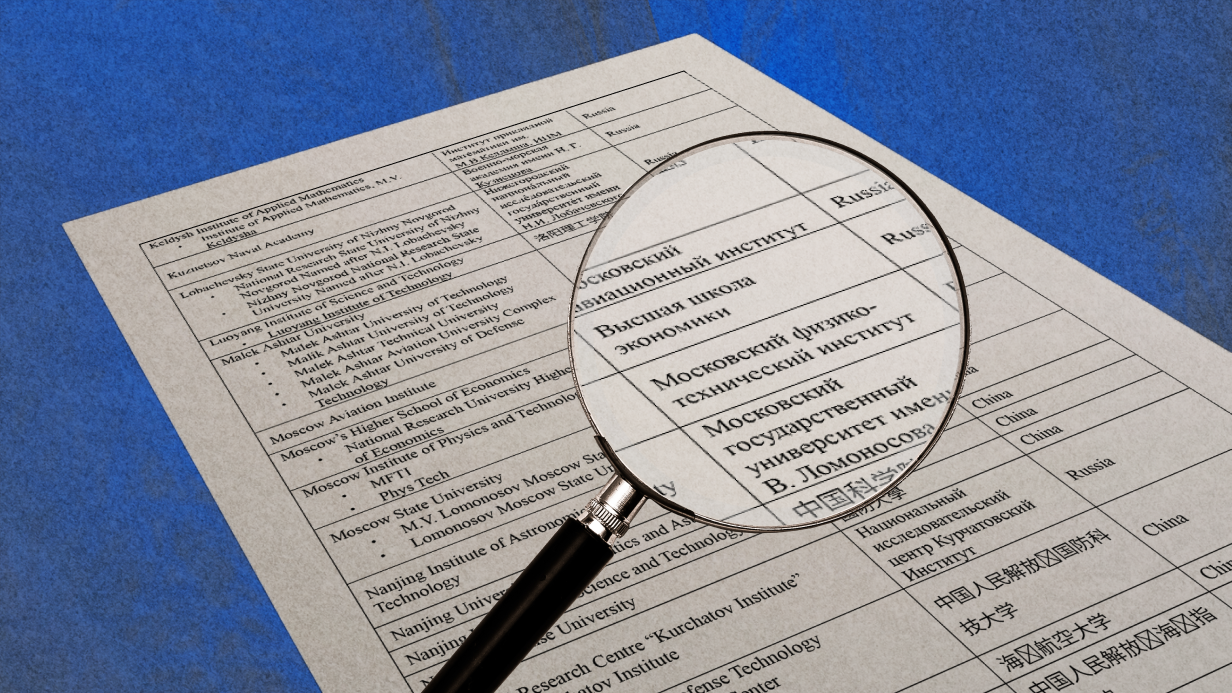
On July 23, the U.S. Department of Defense published a new list of organizations that, according to its assessment, pose a threat to U.S. national security or are engaged in problematic activity. The list includes Moscow State University, Bauman Moscow State Technical University, the Higher School of Economics, Ural Federal University, and numerous other universities and research institutes. The Pentagon believes that these organizations may aim to steal American intellectual property, research data, technologies, and scientific innovations. The Department therefore urges American universities, research institutes, and individual scholars receiving Department of Defense funding not to collaborate with them in any way, exchange data, or provide financial support. Notably, this list is not identical to existing U.S. sanctions lists (read more: “Scientific Front: Who in Russian Science Ended Up Under Western Sanctions — and Why”) and it appeared at a time when, according to Reuters, the U.S. administration has significantly reduced efforts to enforce sanctions against Russia. T-invariant explores what this new policy means for American and Russian academia, how it differs from sanctions law, and who is likely to be affected.
T-INVARIANT BRIEFING
The restrictions certainly apply to:
- Researchers affiliated with the listed organizations and working in physics, chemistry, biology, engineering, technology, and defense-related fields.
- American universities and colleges receiving funding from the U.S. Department of Defense.
They are highly likely to affect:
- All employees of listed institutions, regardless of their academic discipline.
- Students of the listed universities when applying to conferences or submitting articles to journals affiliated with American universities or companies.
- Universities, colleges, research institutes, think tanks, and other organizations worldwide that receive funding from the U.S. government.
The restrictions might affect:
- Students and graduates of these institutions when applying to American universities.
- Universities in third countries participating in projects funded by the U.S. government.
- Researchers at other universities and institutes in Russia, Iran, and China.
The list was issued as an implementation of Section 1286 of the John S. McCain National Defense Authorization Act (NDAA) of 2019. The NDAA is a law that is issued every year and that determines the structure and budget of the U.S. military, including troop numbers, defense spending, modernization programs, and other issues. However, alongside military provisions, Congress also includes neighboring measures, such as foreign policy objectives, and funding allocation. The 2019 NDAA received broad bipartisan support and was signed by President Donald Trump. Compared with previous versions, it increased the military budget, while shifting America’s strategic focus in foreign policy away from counterterrorism toward long-term competition with China and Russia, with considerably greater emphasis on China. This legislation was especially discussed in the media due to the restrictions of Section 889 targeting Chinese technology companies such as Huawei and ZTE.
As part of the same great power competition strategy, Congress included provisions designed to protect American academic research from foreign influence and intellectual property theft. Section 1286, which received the updated list of “problematic organizations,” is titled Initiative to support protection of national security academic researchers from undue influence and other security threats and it specifically addresses universities conducting defense and technology research. Although Congress passes a new NDAA every year, the Pentagon continues updating the same list of the Section 1286 of NDAA 2019 because the 2019 law explicitly requires the Department of Defense to revise it on a regular basis. The July 23 publication is therefore not a new law, but the latest update of an existing mechanism. Being published every year, these updates all have special emphasis, relevant for the moment. For instance, the 2025 version is primarily aimed at preventing foreign influence over research sponsored by the Department of Defense.
Such activities as funding sanctioned organizations, or exchanging data, were already prohibited by sanctions laws. Also, scholars employed by those organizations could not participate in conferences, or get published in the leading journals if they maintained formal affiliations. There are three fundamental points of difference between the new Pentagon list and sanctions: who is affected, who enforces the law, and what the consequences of violations are.
Who is affected?
Previous sanctions and earlier lists (such as the 2023 Section 1286 list) targeted a relatively small number of universities involved mainly in military technology development or, in Russia’s case, in promoting state propaganda. Moreover, the restrictions were generally limited to individual representatives or to specific institutes. Before the new list appeared, the largest Russian research center to be included in such restrictions in its entirety was Skolkovo, which was added in 2023 – and in that case, it was hardly surprising.
This time, however, the Pentagon included 13 Russian universities as whole bodies, and those were not only institutions specializing in engineering, physics, and biology, but also several major multidisciplinary universities, including Moscow State University (MSU), the Higher School of Economics (HSE), and Ural Federal University (UrFU). Several of China’s leading multidisciplinary universities, including Fudan University and Shanghai Jiao Tong University, were also added. HSE employees, speaking on condition of anonymity, told T-invariant that until now they had been able to collaborate with Western universities as private researchers without listing their affiliation, they participated in conferences online and sometimes even in person, conducted joint research, and published articles.
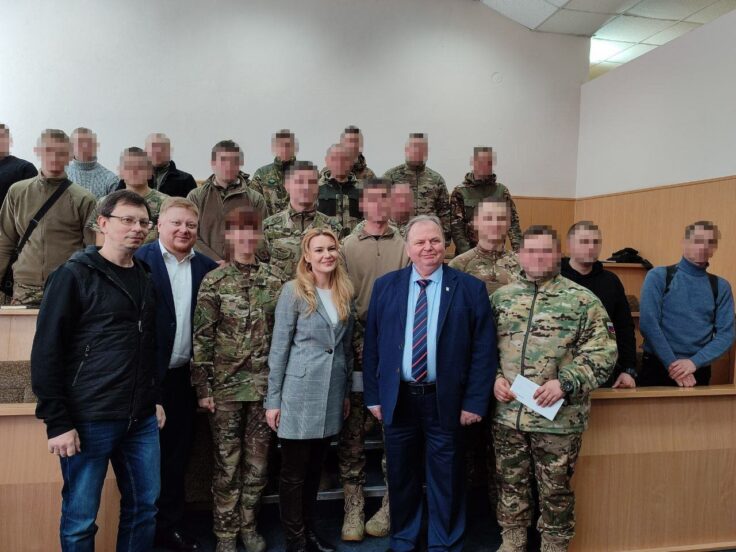
However, the wording of the new document makes it possible to extend the restrictions to employees of the listed organizations themselves. This means that concealing one’s institutional affiliation and presenting oneself as an independent researcher may no longer be sufficient to circumvent the restrictions: any collaboration between American researchers and scholars who are simply employed by universities on the list falls under Pentagon restrictions. Moreover, even though most organizations on the list conduct research in physics, technology, and such, the policy could affect physicians, historians, and even scholars of the Swahili language.
Who enforces the restrictions?
Another noteworthy aspect is that these measures operate through the National Defense Authorization Act, meaning they are administered by the Department of Defense, unlike the traditional sanctions system. Sanctions are often described as decisions made by the U.S. government as a whole, but departments matter. In reality, Sanctions legislation is passed through Congress or came in force by a presidential decree, and enforcement is typically carried out by either the Treasury Department or the Department of Commerce. But this list is neither a sanction imposed for specific actions, nor a punishment for participating in war or violating the law. Instead, it is presented as a preventive measure designed to protect American research and technology from national security threats. Meanwhile, the official sanctions lists themselves do not receive any updates, and President Trump has repeatedly signaled a willingness to improve relations with leaders of countries that remain under U.S. sanctions.
The Department of Defense is publishing this update because it is legally required to. At the same time, it does not provide any specific evidence demonstrating that every organization included is “engaging in activities that threaten U.S. national security interests.” The use of national security and foreign influence concerns as justifications for government intervention in science, media, and business is all too familiar from the Russian experience and feels rather unsettling. That is why it is important to understand what this policy means not only for Russian science, but also for American academia.
After taking office, President Trump began exerting significant pressure on American universities. His primary targets were campus protests and the promotion of woke ideas concerning equality and the rights of gender, racial, and sexual minorities. The principal tool was the threat of cutting off federal funding. Yet even during Trump’s first presidency, the administration had already started intervening in universities through the concerns of espionage, and in 2018, the Department of Justice launched the China Initiative. According to the MIT Technology Review, the effectiveness of the initiative is highly questionable, partly because the Department of Justice never clearly explained its concrete objectives beyond broad references to protecting American technology and combating espionage. It also failed to clarify the criteria used to initiate investigations. Information about many cases never appeared on official government websites, some records were removed following media inquiries and requests for comment, and only about one quarter of the cases received actual convictions. Moreover, many prosecutions had no obvious connection to national security. This precedent is especially significant in light of the new Section 1286 list, as a precedent. As follows from the name of the programme, approximately 90% of those prosecuted under China Initiative were scholars of Chinese origin, and members of Asian diasporas were subjected to disproportionate scrutiny by law enforcement. MIT Technology Review argues that one of the initiative’s most damaging consequences was the brain drain of highly qualified researchers from the United States. Scientists and scholars were leaving because of the discrimination and pressure from the law enforcement, and it became harmful for the American science itself.
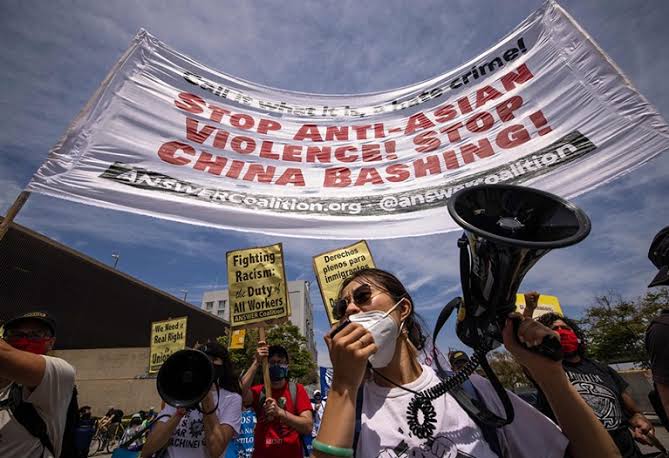
During President Biden’s administration, the espionage agenda receded somewhat into the background, but it reemerged, as Trump took office again. On March 26, 2026, the House Committee on Education and the Workforce heard reports on the activities of foreign intelligence services on university campuses. Once again, the discussion focused primarily on alleged espionage involving Chinese students, the recruitment of American students on campus, and cases in which researchers were drawn into projects without being informed on the true purpose of the research. It is worth noting that in his opening remarks, the committee chair emphasized that international collaborations should benefit America rather than its rivals. This idea contradicts the traditional understanding of academia as a transnational space for free exchange of knowledge. International conferences, academic and cultural exchanges, collaborative research, and multinational projects have advanced and benefited science worldwide for decades. As with the China Initiative, extending the logic of national security into universities and scientific research challenges this principle and contributes to the isolation of American science.
At the same time, it would be wrong to deny that espionage, foreign interference in academia and business, and theft of American intellectual property do exist. Roughly one quarter of China Initiative prosecutions ended in convictions, and over the past year, several cases have emerged involving Chinese intelligence agents infiltrating American academic institutions. But these cases differ in one respect, crucial for the NDAA 2019 list: the spies concealed their connections to Chinese universities, military structures, or intelligence agencies. They would typically enter the United States as students, visiting researchers, fellows, or even professors while hiding their institutional ties. They transferred research data and intelligence to the Chinese government, smuggled research materials into or out of the country – it seems that Ksenia Petrova was detained because of this atmosphere of heightened suspicion within academia.
There were also cases of recruiting American students and professors, but it generally happened through malign foreign talent recruitment programs, in which American researchers participated without being informed who would ultimately receive the results of their work or for what purpose. The 2024 version of the Pentagon list was specifically aimed at preventing this practice.
An even more common instrument of espionage has been cyberattacks, like the case reported recently by The Insider. In this case, Microsoft uncovered a scheme that allowed hackers to gain access to data from every device connected to compromised hotel Wi-Fi networks during academic conferences.
Journalist Roman Dobrokhotov described the method for the TVRain channel: “When you try to log in, your credentials get stolen. In the worst case scenario, you’re prompted to download software or click ‘OK’ or ‘YES,’ and a real spyware virus gets onto your laptop. It steals all your passwords and captures everything you type on the keyboard. If a conference has a thousand participants, it is enough just for two or three people to download the malware for the operation to succeed.” According to The Insider, “the group primarily targets governments, diplomatic missions, NGOs, and IT companies in the United States and Europe in order to collect intelligence supporting Russian foreign policy.”
All of these espionage cases share an important point: every time, the perpetrators concealed the affiliations with the organizations they were truly working for, they frequently used false documents, or even operated remotely. This raises a doubt as to the effectiveness of a ban on cooperation with specific universities. Such a policy is unlikely to counter the methods actually used to steal research data.
How grave are the consequences?
The third major difference between this list and sanctions packages lies in the mechanism of the restrictions: the Department of Defense does not put a ban on the activities of the listed organizations, but it is restricting its own ability to fund them. The universities included in the list, their employees, or American scholars – none of them will face prosecution by law enforcement. However, the Pentagon restricts its ability to provide funding to universities, institutes, or individual researchers who continue collaborating with listed organizations or their employees, or who use their equipment.
At first glance, it might seem that losing such a niche source of funding would hardly affect fields unrelated to the military. For instance, professor of Russian literature Oleg Lekmanov, who taught at Princeton University, expressed precisely this view: “As I see it, this is not relevant to the humanities, because no one from the military sector offers us funding in the first place.” However, the Pentagon has numerous programs and foundations that finance research, and not only in fields related to defense, but also in biology, psychology, medicine, linguistics, the social sciences, and area studies. For instance, Natalia Korbo, a former targeting analyst for the U.S. State Department Economic Bureau, confirmed to T-invariant that the Department of Defense supports an exceptionally broad range of projects, particularly in STEM – science, technology, engineering, and mathematics.
Moreover, funding extends well beyond STEM disciplines. For example, the Minerva Initiative distributes long- and short-term grants for research intended to help the Department of Defense better understand future challenges and prepare for them. Thus, the participating projects cover a range of disciplines. According to Science, Minerva allocated $24.8 million in 2024 alone to projects involving artificial intelligence, climate change, and migration. Yet, the Science reports that the initiative had already begun drastically reducing its funding, even for projects that appeared directly relevant to defense interests. Among those unexpectedly terminated were studies examining the factors that motivate military personnel to remain in service and the conditions that prevent the collapse of international alliances. And now, it might become even more difficult to obtain Pentagon funding, since applicants will have to demonstrate that no member of a project is affiliated with any organization on the list of “the undesirables.”
Apart from research, the Department of Defense provides funding for educational purposes. It awards scholarships to undergraduate, graduate, and doctoral students studying languages and regions considered “critical to America’s security,” and it sponsors academic centers devoted to these fields.
Judging by the Trump administration’s foreign-policy priorities, particular attention is currently being drawn to South America and the Indo-Pacific region. At the same time, the Middle East, Central Asia, and Russia remain areas of strategic interest as well. Consequently, the publication of the NDAA 2019 list will affect not only researchers in biochemistry, physics, engineering, and technology, but potentially also scholars studying Latin American music or Chinese dance if their academic center receives Pentagon funding.
Moreover, it is unclear whether the funding will be lost only by a project or an institute who maintains ties with a banned organization, or the research of the whole university will be considered compromised in case one body continues collaborations. It is entirely possible that if even one department within a university depends on Department of Defense funding, restrictions on collaboration with listed organizations could apply to the university as a whole.
Furthermore, the preamble to the document contains another provision that may substantially broaden its practical impact. Formally, the list applies only to Department of Defense grants, scholarships, contracts, and other financial support. However, it also warns that cooperation with listed organizations may negatively impact scholars’ eligibility for federal funding. And that is a much more serious prospect. The U.S. federal government finances roughly half of all research and maintenance expenditures at American universities and colleges. Federal money also supports countless scholarships, research grants, and academic conferences. In this light, universities will hardly risk losing access to federal funding, even if the document merely warns of possible consequences rather than imposing an explicit prohibition.
Denis Simon, Senior Research Fellow at the Quincy Institute for Responsible Statecraft in Washington, argues that the U.S. government has effectively stopped distinguishing between leading civilian universities and institutions engaged in security-related research. He also believes American organizations will most likely interpret the conditions of the NDAA 2019 list very broadly. Simon further suggests that universities may begin limiting interaction not only with the organizations explicitly named on the list, but also with other research institutes in Russia, China, and Iran.
A similar concern is expressed by Evgeny Roshchin, Visiting Fellow at the Center for Global Policy of the SAIS School of Advanced International Studies: “On the one hand, the document concerns the research funded through Department of Defense grants. On the other hand, the disciplinary boundaries are not specified. That means it could apply to virtually any field of research, including economics, if it is financed through Pentagon grants. Researchers applying for federal grant competitions will also have to disclose all of their connections with people affiliated with organizations on the list. The existence of such connections may reduce their chances of receiving funding. I believe this will become the main deterrent. Of course, everything will depend on how the rules are applied, but the policy could seriously damage academic cooperation, because some researchers might choose to abandon perfectly legitimate collaborations simply to avoid the risk.”
According to research data, international collaboration is a significant driver of scientific progress. Natalia Korbo believes that while some restrictions are understandable, a blanket prohibition is deeply misguided:
“I understand the logic behind banning joint research in fields like bioengineering or physics, although spies are smart enough not to be affiliated with problematic institutions. But prohibiting all collaboration is simply foolish. It will harm both American science and scientific research worldwide. The restrictions will absolutely affect cultural studies as well. Even the closure of the Confucius Institutes had negative consequences for Americans themselves. Yes, those institutes promoted the Chinese government’s propaganda, but in most American cities they were also the only places where people could learn Chinese. These kinds of bans, like the TikTok ban, are often poorly thought out and produce enormous collateral damage.”
A similar view is shared by Anton Kapustin, professor of physics at the California Institute of Technology: “First, I believe these are serious restrictions, and they extend well beyond defense-related research. Originally, they applied only to projects sponsored by the U.S. Department of Defense. But similar restrictions have since been introduced for grants from the Department of Energy, the National Science Foundation, and other agencies. In practice, they now affect almost all federal grants. Second, the list of proscribed entities grows every year. Now it includes MIPT, HSE, and Moscow State University. If a student has co-authored publications with researchers from these institutions, any American university will think twice before admitting that student to a PhD program, because it will most likely be unable to pay their stipend using federal grant money. There are still many uncertainties, of course, but I think universities will prefer to be overcautious. And obtaining visas will also become more difficult for such students. So the consequences could be very serious.”

Thus, for Russian researchers, the publication of the list may result in profound professional difficulties. But how capable are these restrictions of protecting American interests? And is the loss of cooperation with Russian, Iranian, and Chinese colleagues truly significant for U.S. science?
Entrepreneur Oleg Tinkov argued in an interview with journalist Mikhail Fishman on TV Rain, that Russian universities continue to produce exceptionally strong specialists: “Whatever we may say about Putin’s Russia, or Russia in general, its universities and education – especially in mathematics, computer science, physics, and chemistry – remain exceptionally strong, even compared with the United States. I still think Russian education firmly belongs among the world’s top five, and specialists from Russia are highly valued.”
Academic collaborations with China seem to be even more important for American science. Over the past decade, Chinese science has dramatically strengthened its global position. China ranks second in the world in the number of scientific publications. In 2024, for the first time, Chinese researchers published more papers in leading natural science journals than American scientists did, exceeding the US by 17%. Niccolò Pisani et al. emphasize that China’s success has been driven largely by international collaboration and sustained government investment. Consequently, the restriction of scientific cooperation with China can also have an objective of slowing China’s scientific progress. But such a strategy is likely to have limited effectiveness as long as other leading countries continue collaborating with Chinese researchers. Meanwhile, American science itself risks losing specialists and forfeiting one of its greatest competitive advantages: participation in the global scientific community.
As Denis Simon argues, “the policy is likely to accelerate the fragmentation of the US-China scientific relationship, including in fields that have traditionally relied on open exchanges and multinational research teams. It could also limit US researchers’ access to some of the world’s most productive scientific institutions.” Simon also questions whether the policy is genuinely capable of slowing China’s scientific development.
The publication of the 2025 Section 1286 list may therefore substantially limit cooperation between American researchers and colleagues from Russia, Iran, and China. Although at first glance, the restrictions appear to apply only to defense-related research, they are likely to affect a much broader range of academic disciplines. The precedent of prosecuting cases unrelated to security topics, set by the China Initiative, demonstrated that a program announced with narrow security objectives could, in practice, be applied much more broadly. Meanwhile, the threat of losing Pentagon funding and risk of losing eligibility for other forms of federal support are sufficiently serious that many universities are likely to abandon collaborations with listed institutions simply to avoid the risk. The inclusion of major civilian universities such as Moscow State University and the Higher School of Economics potentially affects thousands of scholars who have no connection to military research. It will be harder if possible to participate in American conferences, conduct joint research, or publish in academic journals, even if they present themselves as independent researchers and do not list their institutional affiliation. Even the students from these universities, even though the restrictions do not formally prohibit them from applying to American colleges or universities, may face indirect consequences if institutions, fearing the loss of federal funding, begin extending these restrictions to graduates of listed universities as well. The policy may also affect universities outside the United States that are closely integrated into the American academic system, particularly those receiving U.S. funding. Such institutions may likewise begin limiting cooperation with researchers affiliated with organizations on the list.
Ultimately, the measures intended to protect American science may not only create serious obstacles for researchers from Russia, China, and Iran, but they may also undermine one of the fundamental strengths of American academia itself – international collaboration and the free exchange of knowledge.